student engagement
Select an item by clicking its checkbox

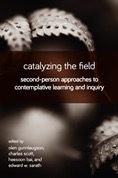
Catalyzing the Field: Second-Person Approaches to Contemplative Learning and Inquiry
Gunnlaugson, Olen; Scott, Charles; Bai, Heesoon; Sarath, Edward W.
SUNY Press, 2019
Book Review
Tags: collaborative learning | student engagement | student learning
Reviewed by: Beverley McGuire, University of North Carolina Wilmington
Date Reviewed: June 17, 2021
Date Reviewed: June 17, 2021
A rich collection of essays about the inner, shared experiences of participants engaged in second-person approaches to contemplative practice.
Catalyzing the Field presents a diverse series of applied case studies about the second-person dimension of contemplative learning in higher education. As a companion volume to the editors’ previous book, The Intersubjective Turn, the contributors to this book explore various pedagogical scenarios in which intentional forms of practice create ...
Catalyzing the Field presents a diverse series of applied case studies about the second-person dimension of contemplative learning in higher education. As a companion volume to the editors’ previous book, The Intersubjective Turn, the contributors to this book explore various pedagogical scenarios in which intentional forms of practice create ...
A rich collection of essays about the inner, shared experiences of participants engaged in second-person approaches to contemplative practice.
Catalyzing the Field presents a diverse series of applied case studies about the second-person dimension of contemplative learning in higher education. As a companion volume to the editors’ previous book, The Intersubjective Turn, the contributors to this book explore various pedagogical scenarios in which intentional forms of practice create and guide consciousness. Their essays demonstrate that practice is not only intellectual, but somatic, phenomenological, emotional, and spiritual as well. Along with their first book, Contemplative Learning and Inquiry across Disciplines, the editors craft an essential body of work that affirms the fundamental importance of contemplative practice in institutions of higher learning. (From the Publisher)
Catalyzing the Field presents a diverse series of applied case studies about the second-person dimension of contemplative learning in higher education. As a companion volume to the editors’ previous book, The Intersubjective Turn, the contributors to this book explore various pedagogical scenarios in which intentional forms of practice create and guide consciousness. Their essays demonstrate that practice is not only intellectual, but somatic, phenomenological, emotional, and spiritual as well. Along with their first book, Contemplative Learning and Inquiry across Disciplines, the editors craft an essential body of work that affirms the fundamental importance of contemplative practice in institutions of higher learning. (From the Publisher)